
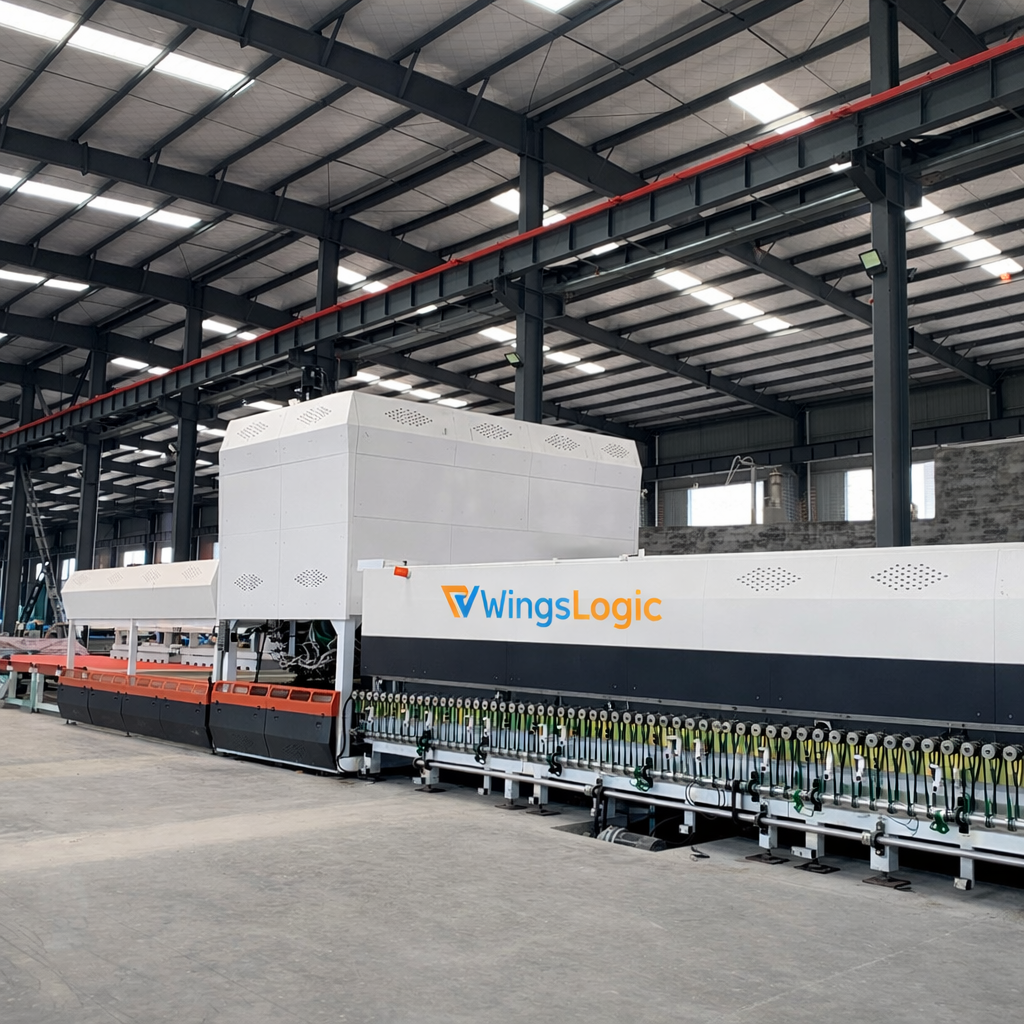

Chamber 1 – Primary Heating Zone
- Rapid and uniform glass heating
- Initial temperature ramp-up
- Overcoming coating reflectivity (Low-E glass)
- Advanced convection heating
- Hybrid convection-radiation systems
Chamber 2 – Soaking & Thermal Stabilization Zone
The second chamber focuses on:- Temperature equalization
- Stress homogenization through glass thickness
- Edge-to-center thermal balance
- Optical quality
- Stress uniformity
- Reduced breakage
Furnace Chamber & Structural Engineering
Heavy-Duty Dual Chamber Frame
The furnace body uses:- Reinforced structural steel
- Thermal expansion compensation design
- Independent chamber insulation zones
- Mechanical rigidity
- Long-term alignment stability
- Minimal heat loss between chambers
Advanced Insulation & Thermal Isolation
Each chamber is insulated independently using multi-layer high-temperature insulation, preventing thermal interference. Benefits include:- Stable temperature control
- Reduced energy waste
- Improved heating accuracy
Convection & Heating System Design
Independent Heating Zones
Both chambers are divided into multiple independently controlled zones, enabling:- Local temperature correction
- Edge compensation
- Thickness-specific tuning
Advanced Airflow & Heat Transfer
In convection-based designs, Wings Logic uses:- High-efficiency blowers
- Optimized air duct geometry
- Precision nozzle arrays
- Uniform heat penetration
- Minimal turbulence imbalance
- Consistent surface heating
Glass Transport & Synchronization
Precision Ceramic Roller System
Glass moves through both chambers on high-precision ceramic rollers, engineered for:
- Dimensional stability
- Smooth rotation at high temperature
- Minimal surface marking
Roller alignment and speed synchronization are critical to avoid:
- Roller wave
- Optical distortion
- Edge stress variation
Chamber-to-Chamber Transfer Control
The transition between chambers is digitally synchronized to ensure:
- No temperature shock
- No speed mismatch
- No glass instability
This seamless transfer is what enables continuous high-speed production.
Quenching System – Converting Thermal Control into Strength
High-Performance Quench Engineering
After exiting the second chamber, glass enters the quench section, where:
- Surface compression is induced
- Internal tensile stress is controlled
Wings Logic quench systems feature:
- Independent top & bottom air pressure control
- Uniform nozzle distribution
- Adjustable quench intensity
This ensures:
- Consistent fragmentation pattern
- High mechanical strength
- Excellent optical quality
Optical Quality & Stress Profile Control
Double chamber furnaces excel in producing optically superior tempered glass because:
- Glass reaches thermal equilibrium before quenching
- Stress gradients are minimized
- Surface distortion is reduced
Wings Logic systems minimize:
- Anisotropy
- Roller wave
- Edge deformation
This makes them ideal for architectural and façade glass.
Intelligent Control Software & R&D Logic
Recipe-Based Dual Chamber Control
The control system allows:
- Independent recipes for each chamber
- Thickness-specific heating curves
- Automatic synchronization with quench settings
This provides:
- Repeatable production
- Fast changeover
- Reduced operator dependency
Real-Time Monitoring & Adaptive Correction
Sensors continuously monitor:
- Zone temperatures
- Glass speed
- Chamber stability
The system dynamically adjusts parameters, maintaining process stability under high load.
Energy Efficiency & Operational Economics
Despite higher output, Wings Logic double chamber furnaces are optimized for:
- Efficient energy usage
- Reduced heat loss
- Stable power consumption
Energy efficiency is achieved through:
- Advanced insulation
- Optimized heating cycles
- Intelligent power management
This delivers lower cost per square meter of tempered glass.