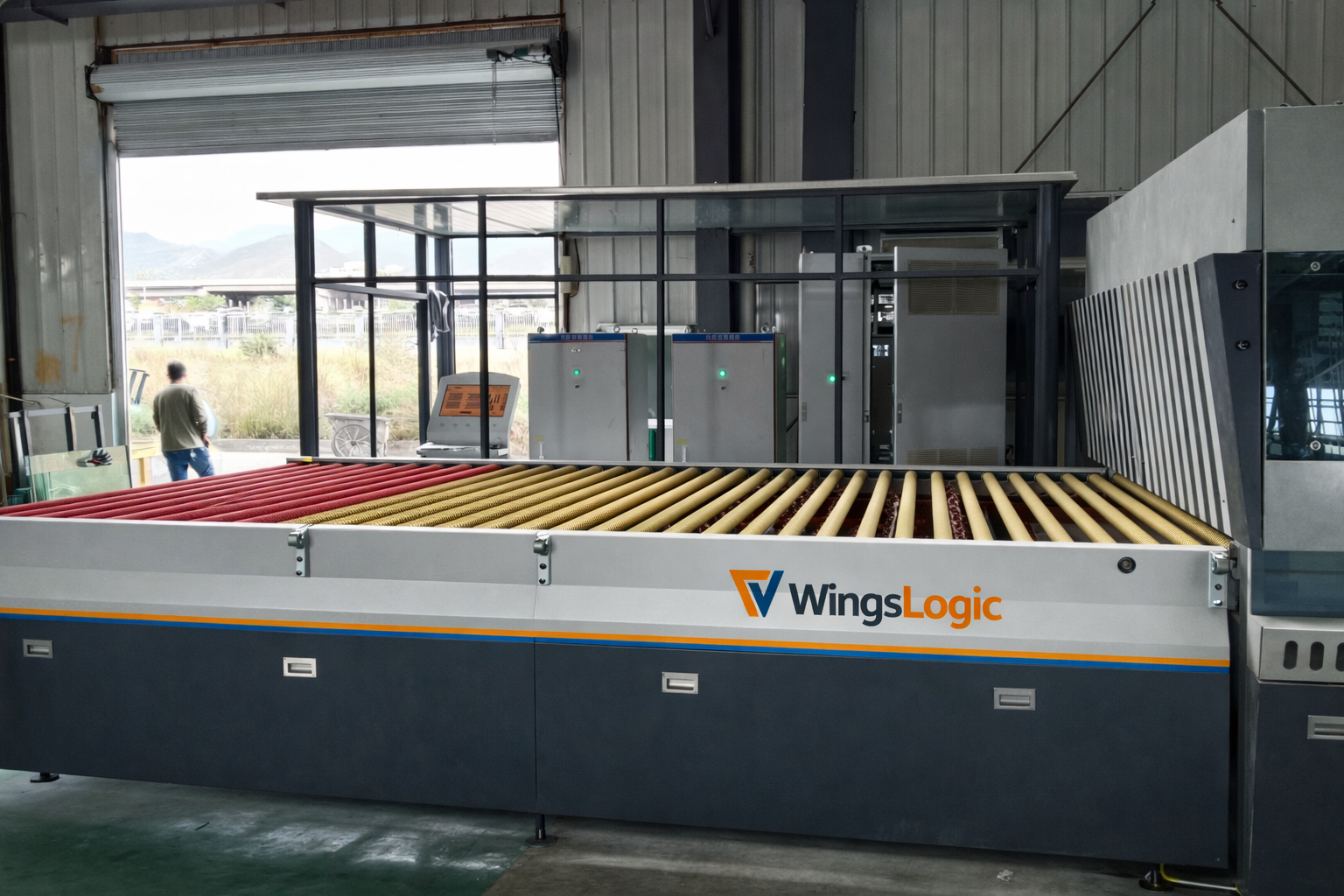
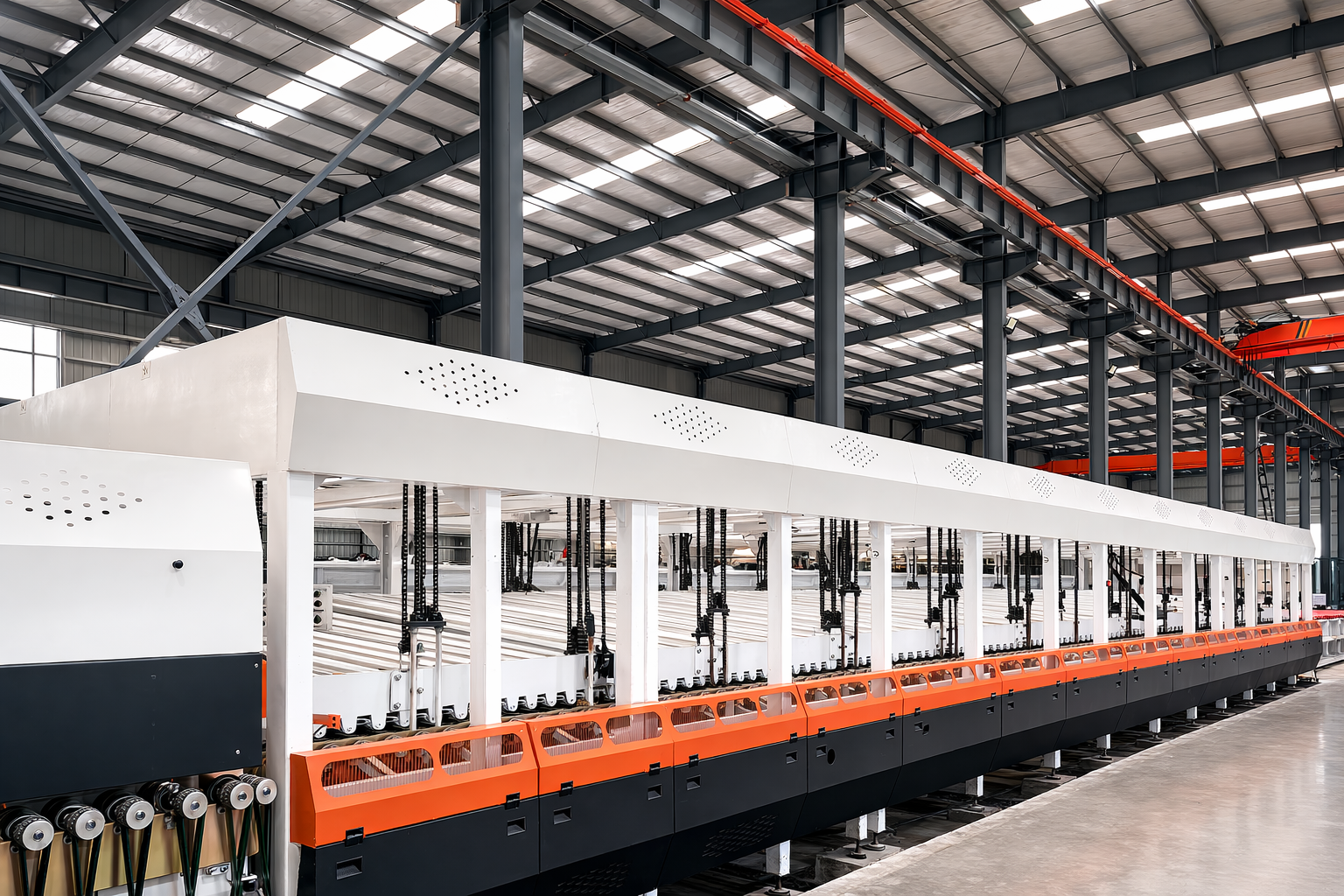

Flat And Bend Convection Furnace

Integrated Tempering & Bending Technology Driven by Advanced Thermal and Mechanical Engineering

The Flat & Bend Convection Furnace represents the highest level of sophistication in glass tempering technology. It is not merely a furnace — it is a precision thermo-mechanical system that combines controlled convection heating, gravity or press bending, and exact stress management into a single, unified production process.
At Wings Logic, flat & bend convection furnaces are engineered through extensive thermal research, forming simulations, and real-world architectural project feedback. These systems are designed to meet the increasing demand for curved, complex, and architecturally expressive glass, without compromising safety, optical quality, or long-term reliability.

Why Flat & Bend Technology Defines Advanced Glass Factories

Modern architecture increasingly demands:
Traditional flat furnaces cannot meet these requirements. Flat & bend furnaces solve this by integrating heating and forming into one synchronized process, ensuring that bending occurs at the optimal glass viscosity window. This integration is what separates true furnace engineering from mechanical improvisation.

Core Engineering Philosophy at Wings Logic

Wings Logic flat & bend convection furnaces are built on five fundamental engineering principles:

Every subsystem — thermal, mechanical, pneumatic, and software — is designed to work as one controlled physical process.

Furnace Chamber & Structural Integrity

Flat & bend furnaces experience both high thermal loads and mechanical forces. Wings Logic uses:
  • Heavy-duty structural steel frames
  • Reinforced bending zones
  • Stress-relieved fabrication
This ensures:
  • Dimensional stability
  • Accurate mold positioning
  • Long-term mechanical reliability
Structural rigidity is essential to maintain bending accuracy over thousands of cycles.
High-Performance Thermal Insulation
The furnace chamber uses multi-layer high-temperature insulation, ensuring:
  • Stable internal temperature
  • Minimal heat loss
  • Protection of forming mechanisms
Thermal stability directly impacts bending repeatability and glass quality.
Forced Hot Air Technology
Unlike radiation furnaces, flat & bend systems rely heavily on active convection heating to:
  • Achieve uniform glass temperature
  • Overcome coating reflectivity (Low-E glass)
  • Control viscosity before bending
Wings Logic furnaces use:
  • High-efficiency convection blowers
  • Optimized ducting systems
  • Precision nozzle layouts
This ensures consistent heat penetration, even for complex shapes and coated glass.
Zone-Based Temperature Control
The furnace is divided into multiple independently controlled heating zones, allowing:
  • Local temperature correction
  • Edge-to-center balancing
  • Thickness-specific heating curves
This level of control is critical to avoid:
  • Uneven bending
  • Optical distortion
  • Residual stress concentration
Gravity Bending System
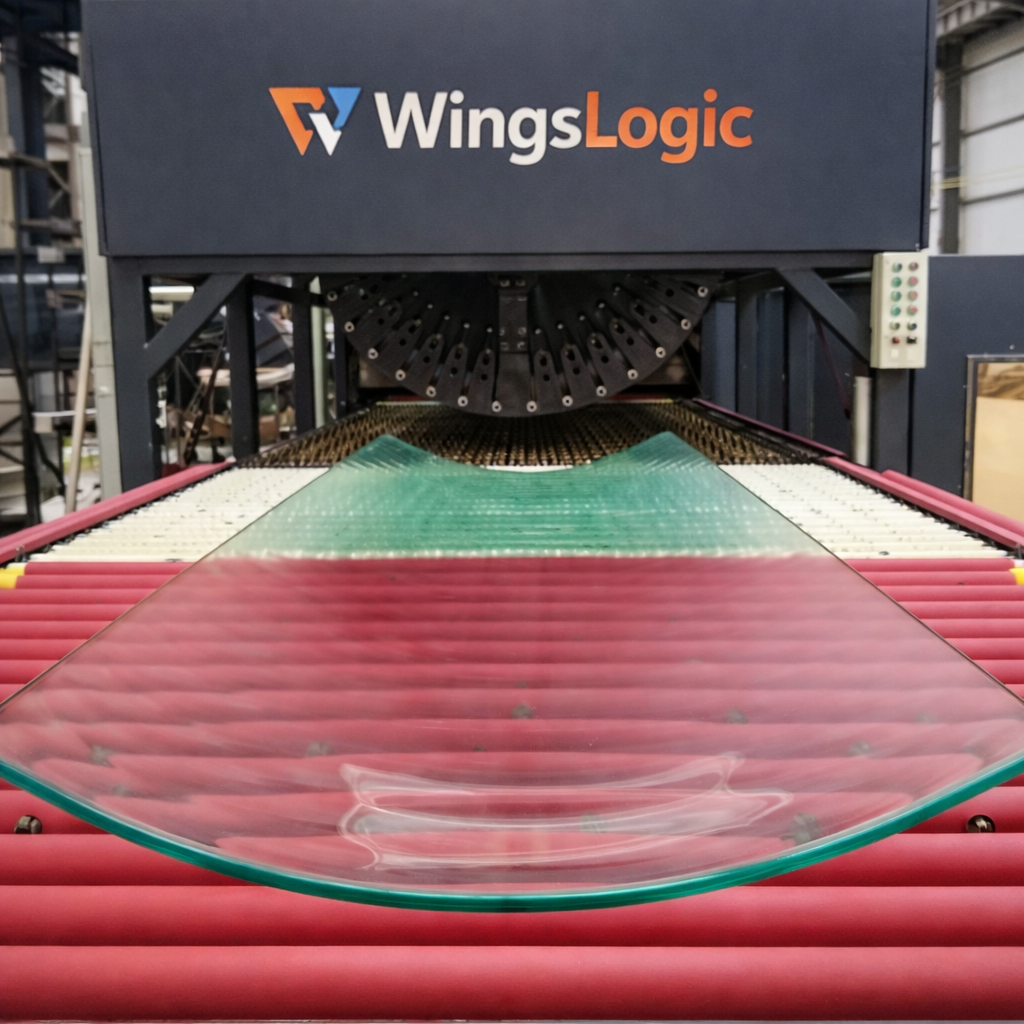
In gravity bending mode, glass softens and gradually bends under its own weight over a precision-machined bending mold. Engineering considerations include:
  • Controlled heating rate
  • Mold material and surface finish
  • Bending radius accuracy
This method delivers natural curvature and excellent optical quality, especially for architectural applications.
Press Bending System (Optional)
For tighter radii and higher repeatability, Wings Logic offers press bending technology, where:
  • Heated glass is shaped using upper and lower molds
  • Forming pressure is precisely controlled
  • Geometry is fixed with high accuracy
Press bending is ideal for:
  • Automotive and façade glass
  • High-volume curved production
  • Strict dimensional tolerances
Precision Mold Design
Bending molds are engineered using:
  • CNC-machined steel or special alloys
  • High-temperature resistant materials
  • Optimized surface geometry
Mold accuracy directly determines:
  • Final glass shape
  • Optical quality
  • Production consistency
Wings Logic treats mold engineering as a core R&D discipline, not an accessory.
Ceramic Roller & Support Technology
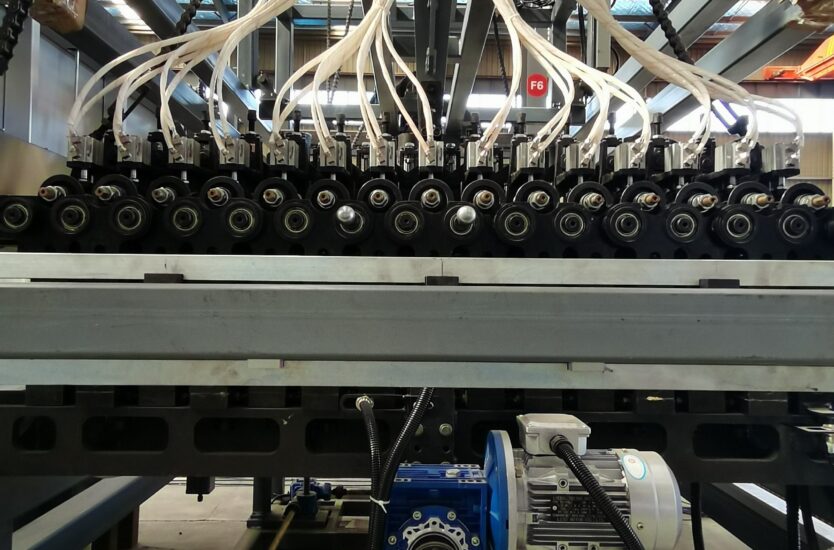
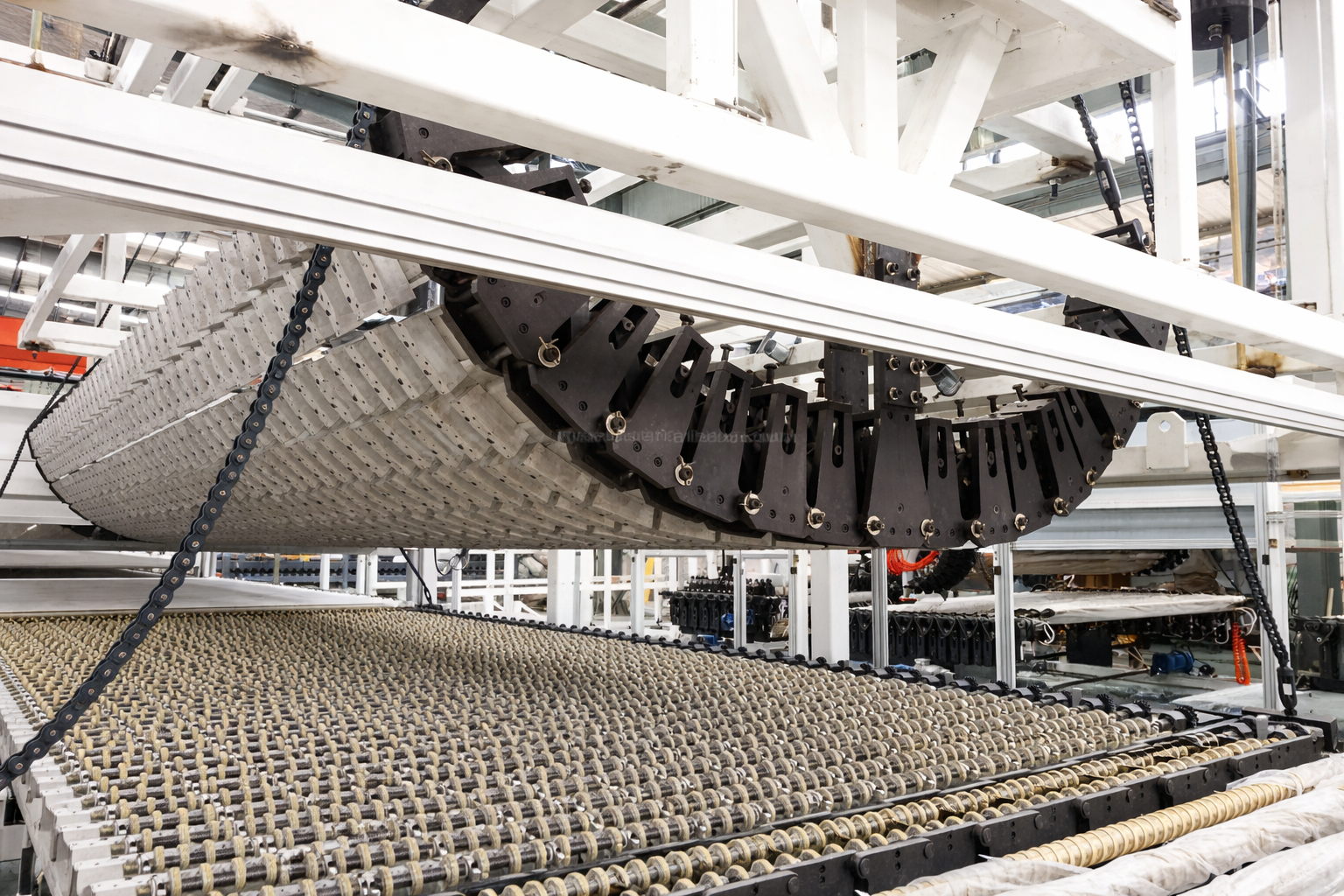
Glass transport through the heating zone uses high-precision ceramic rollers, ensuring:
  • Smooth glass movement
  • Stable thermal exposure
  • Minimal surface marking
During bending, support systems are designed to:
  • Prevent sagging outside intended curvature
  • Maintain edge integrity
Advanced Quench Engineering
After bending, glass must be tempered without altering the achieved shape. Wings Logic quench systems provide:
  • Independent top & bottom air control
  • Uniform nozzle distribution
  • Controlled cooling intensity
This ensures:
  • Proper surface compression
  • Safe fragmentation behavior
  • Shape retention without deformation

Curved glass makes optical distortion more visible. Wings Logic flat & bend furnaces are designed to minimize:

  • Roller wave
  • Anisotropy
  • Surface waviness
  • Edge distortion

This is achieved through:

  • Uniform heating
  • Controlled forming speed
  • Balanced quenching

The result is architectural-grade curved glass.

Recipe-Driven Bending Control
The furnace control system allows:
  • Storage of bending recipes
  • Control of heating curves
  • Bending timing synchronization
  • Quench pressure profiles
This ensures:
  • Repeatability
  • Faster setup
  • Reduced scrap rate
Real-Time Monitoring & Correction
Sensors continuously track:
  • Temperature distribution
  • Glass position
  • Forming sequence timing
The system automatically compensates for variations, ensuring stable output over long production runs.

Despite its complexity, Wings Logic flat & bend furnaces are optimized for energy efficiency through:

  • Efficient insulation
  • Optimized air circulation
  • Intelligent power control

This reduces operational cost while maintaining high-precision performance.

Performance Under Industrial Conditions
Designed for:
All components are selected for industrial reliability, not laboratory demonstrations.
Applications & Market Segments
Flat & Bend Convection Furnaces are essential for:
They enable glass processors to move into premium, design-driven markets.
Service, Support & Engineering Partnership
Wings Logic backs every flat & bend furnace with:
We support not just the machine, but the forming process itself.

Built for Architectural Freedom & Future Design

As architecture moves toward: 

Flat & bend convection furnaces become a strategic capability, not a niche tool.Wings Logic designs systems that enable creative freedom backed by engineering certainty.

Why Customers Trust Wings Logic Flat & Bend Furnaces

Wings Logic does not adapt flat furnaces for bending — we engineer bending as a core process.

Deep understanding of thermal-forming physics

Strong in-house R&D capability

Precision mold engineering

Stable, repeatable bending performance

Professional global service support

Discuss Your Flat & Bend Furnace Requirement